

Spolia Memoriae
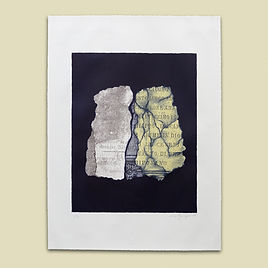
This lithograph takes as its starting point the commemorative plaques on the walls of St. Pierre Church in Galata, Istanbul and the reused stones surrounding them. Created to preserve the memory of individuals, these plaques now appear as structural elements of the wall, while simultaneously bringing together lives and deaths that are entirely different from one another.
On these walls, the story of Filomena, who died at the age of thirteen months, and the name of an ambassador who died in his forties while on diplomatic duty in the Ottoman Empire can be read on the same surface. Lives from different times and places converge in a shared space of memory thanks to the physical proximity of the stones.*
These commemorative plaques were commissioned by families, friends, and members of the congregation who wished to keep the names of their deceased loved ones alive and entrust them to the prayers of those visiting the church. They served as a way to trace the memories that were at risk of being lost with the relocation of the cemeteries. For example, as can be read on the yellow stone on the right, it is recorded on a stone that the ashes of Francesco Boccardo, who died in 1781, were brought from the Pera Cemetery to St. Pierre Church in 1860.
These stories reveal the fragile sense of belonging of the Levantine communities that lived in Istanbul. The fate of these people, who had moved from place to place during their lifetimes, continued after their deaths as their graves were also relocated.** The stones bearing their stories have now become part of the city’s architecture rather than marking the resting places of their bodies.
To tell these stories, the technique of lithography itself has become a conceptual tool. Lithography is a printing technique that works on limestone formed over approximately 300 million years. Transferring the images obtained from graves and memorial plaques onto another stone surface can be thought of as recording the memory of one stone onto the memory of another. Moreover, in lithography, each color is produced as a separate printing layer. In this print as well, the photographic collage I created from the gravestones forms the first layer, while the blue and yellow colors were added to the surface through separate printing processes. This layered structure makes visible both the composition of the reused stones on the St. Pierre wall, which brings together fragments from different eras, and the convergence of disparate life stories on the same surface. Whether they belonged to Istanbul or not, the stories of these people, who lived and died here, continue to exist as indelible layers in the city’s memory.
Although some of these people lived for only four years and others for forty, these stones have been in Istanbul for nearly two centuries, continuing to tell their stories.
* This situation intersects with the story of the Levantine communities once buried in the Pera Cemetery, located on the site of today’s Gezi Park. In 1864, with the demolition of the Galata walls, a decision was made to relocate the cemetery; while many remains were transferred to Feriköy, the gravestones were left behind and, over time, were used as architectural elements or building materials in various structures. Both the place of death and the stones marking it have been displaced.
**These commemorative plaques belong to the luckiest witnesses of this entire process of migration and dispersion. While the graves of many families whose children and grandchildren left Istanbul have been lost, those who remained tracked down their loved ones and commissioned these stones to keep their names and stories alive.


Concept and design: Liana Kuyumcuyan
Master printer: Doğu Güngör, Dou Print Studio
Assistant printer: Reyyan Fidan
Paper size: 47 x 63 cm
Technique: Toner transfer, lithographic pencil and airbrush, and asphaltum
-
The prints can be purchased via douprintstudio.com/tr/shop


